Apple’s 2026 MacBook Pro M5 Max Review: Revolutionary Architecture with New Performance Cores
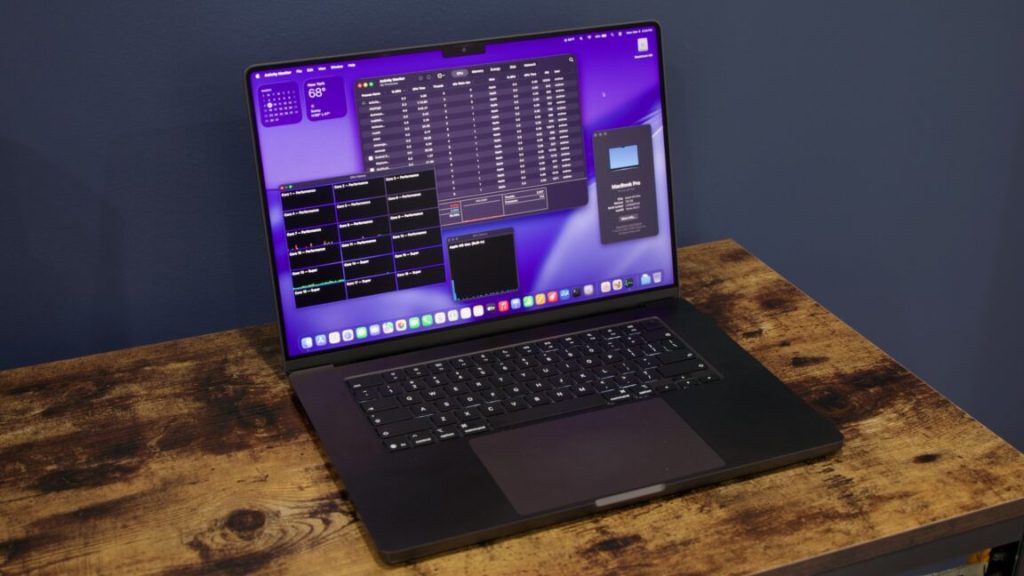
Apple has fundamentally transformed its high-end laptop processors with the introduction of the M5 Pro and M5 Max chips, implementing groundbreaking architectural changes that represent a significant departure from previous Apple Silicon designs.
Revolutionary Fusion Architecture
The most significant innovation in the M5 Pro and M5 Max lies in their construction. Unlike previous generations that featured monolithic chip designs, these processors utilize Apple’s new “Fusion Architecture” to split components across multiple silicon dies. The CPU cores and associated components occupy one die, while GPU cores and related elements reside on a separate die, which are then packaged together into a single chip.
Both M5 Pro and M5 Max variants share an identical 18-core CPU die. The distinction comes in their GPU configurations: the Pro version incorporates a 20-core GPU die, while the Max features a more powerful 40-core GPU die. This separation also affects memory capabilities, as the memory controller resides on the GPU die, giving the Max variant superior memory bandwidth and capacity compared to the Pro.
New Core Architecture and Naming
Another major shift involves the elimination of traditional efficiency cores in the Pro and Max variants. Apple has restructured its core naming convention, with the fastest cores now designated as “super” cores across all M5 family processors. The standard M5 retains its efficiency cores, but the Pro and Max models introduce a third category called “performance” cores.
The M5 Max configuration includes up to six super cores and up to twelve performance cores, with no efficiency cores present. This represents a dramatic change from the M4 Max, which featured up to twelve performance cores and four efficiency cores. Memory bandwidth has also increased significantly, with the M5 Max offering up to 614 GB/s compared to the M4 Max’s 546 GB/s.
Performance Analysis
Testing reveals that the M5 Max delivers approximately 10 percent improvement in single-core performance compared to its M4 predecessor. Multi-core performance gains vary by application, with most benchmarks showing modest 10-12 percent improvements, though some tests like Cinebench R23 demonstrate up to 30 percent gains.
Graphics performance shows more substantial improvements, ranging from 20 to 35 percent depending on the specific test. Apple suggests even greater performance gains may be possible with GPU compute workloads that can leverage the neural accelerator integrated into each M5-family GPU core.
When compared to the standard M5, the Max variant maintains similar single-core performance while delivering 66-120 percent improvements in multi-core tasks. The GPU performance difference is even more dramatic, with the 40-core M5 Max typically providing three to four times the graphics capability of the 10-core standard M5.
Understanding the New Performance Cores
The introduction of the new “performance” cores has generated considerable discussion about their true nature. Technical analysis confirms these are not simply rebranded efficiency cores but represent genuinely new designs derived from the super core architecture.
The performance cores feature 128KB L1 instruction cache, 64KB L1 data cache, and 8MB L2 cache per cluster. Their clock speeds range from 1,344 MHz minimum to 4,308 MHz maximum, significantly higher than the standard M5’s efficiency cores, which operate between 972 MHz and 3,048 MHz. This places the performance cores only 300 MHz below the super cores’ 4,608 MHz peak frequency.
Internal system monitoring tools reveal that macOS identifies these performance core clusters as “M0 cluster” and “M1 cluster,” distinguishing them from both the “P-cluster” designation for super cores and “E-cluster” for efficiency cores.
Thermal and Power Characteristics
Under sustained workloads, the M5 Max demonstrates interesting thermal behavior. The super cores maintain peak performance briefly before settling to sustained speeds around 3.9 GHz, while the performance cores operate more consistently at 4.2-4.3 GHz without significant throttling. This behavior pattern suggests the performance cores provide much of the chip’s sustained multi-core performance advantage.
Power consumption has increased modestly, with the M5 Max drawing approximately 23 percent more power than the M4 Max during intensive tasks. However, overall energy efficiency remains competitive with previous Apple Silicon generations.
The 2026 MacBook Pro continues using the same external design introduced in 2021, which has proven durable and well-received compared to earlier Intel-based models. For users upgrading from M1 or M2-based systems, the performance improvements represent a substantial leap forward, while the transition from M4 Max involves more incremental but still meaningful gains.